
12 Classic Christmas Short Stories That Bring the Season Back
Twelve complete stories, one for each night before Christmas, from Tolstoy, Chekhov, Wilde, Andersen and more. Short enough to finish, strong enough to bring the feeling back.
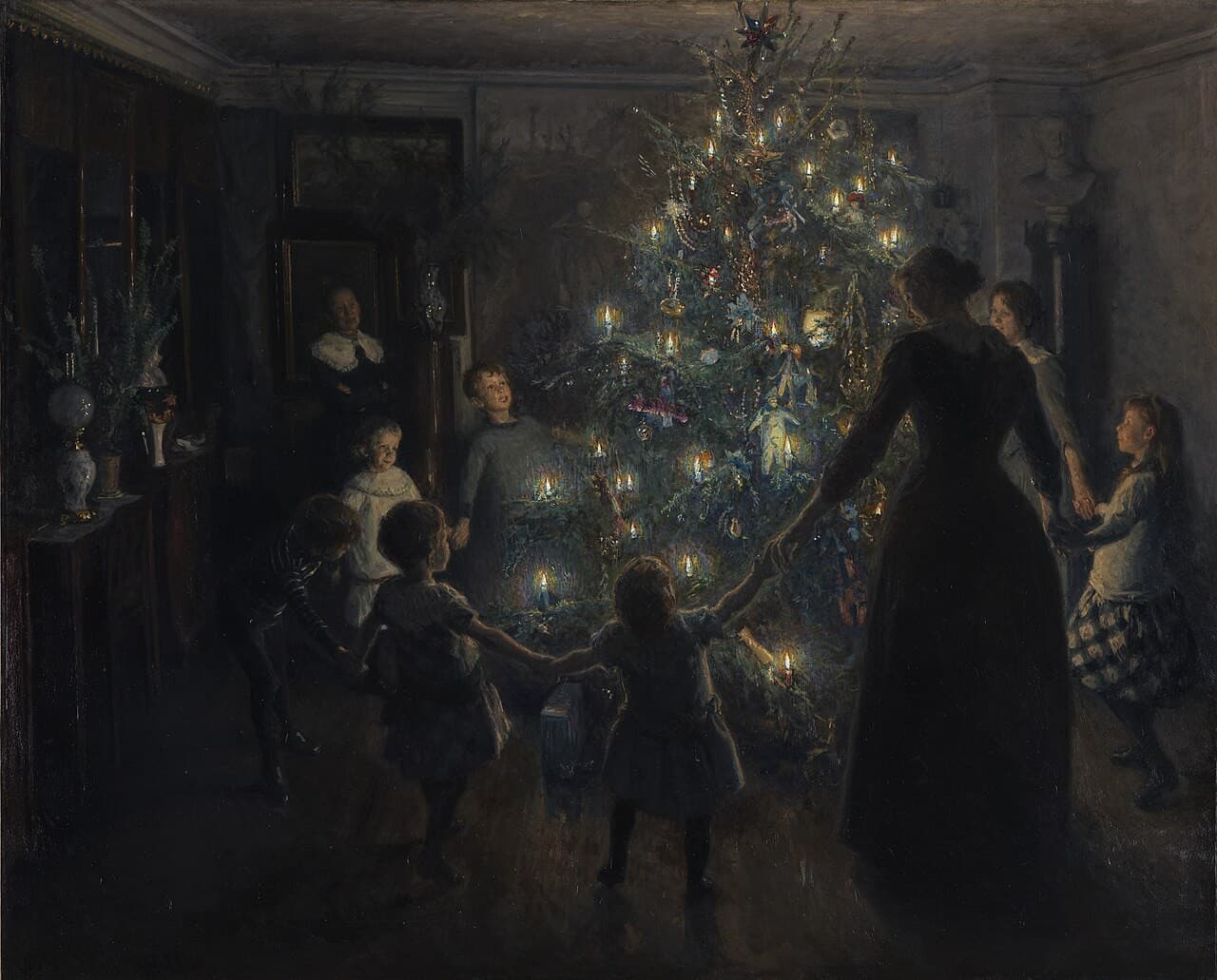
Most of us try to save Christmas by adding to it. One more string of lights, one more tin of cookies, one more movie we could recite in our sleep. By the middle of December the house is warm, full and loud, and the feeling we were chasing still hasn’t arrived.
These twelve stories suggest we’ve been standing on the wrong side of the glass.
Nearly every one of them happens at a lit window. Chesterton presses his nose to a toy-shop window on a grey street in Battersea. A barefoot girl huddles in the snow between two houses on the last night of the year. A nine-year-old in Moscow writes to his grandfather by the light of one candle. An old shoemaker in a basement knows his neighbors only by the boots that pass his window. A giant builds a wall around his garden and finds that winter never leaves.
So here is the point, plainly. Christmas spirit isn’t something you make by getting warmer. It comes back when you notice who is cold.
Nobody inside a lit room can see the lit window. These stories walk you outside for ten minutes at a time, and that is how the feeling returns.
Who wrote them
The names alone would fill a syllabus: Tolstoy and Chekhov, the two great Russians; Selma Lagerlöf, the first woman to win the Nobel Prize in Literature; Andersen, Wilde, Stevenson and Chesterton. There’s a sixteen-year-old Fitzgerald writing for his school magazine, and the police reporter who photographed New York’s tenements.
But nobody here was building a monument. They wrote these pieces for newspapers, a school magazine, an almanac and a church congregation, for ordinary people with a few minutes to spare. That’s why they still work on a tired December evening.
“Aren’t some of these sad?”
Yes. A child freezes. A letter never arrives. A man commits murder on Christmas Day. It’s fair to ask why sad stories would help anyone’s Christmas.
Because sadness isn’t the opposite of Christmas. Numbness is. The first Christmas was a child born in the cold to parents who couldn’t find a room. A story that makes you feel the cold again does more for your December than a dozen that keep you cozy.
And for every match girl, there’s a band of newsboys emptying their savings into a stocking.
1. The Holy Night
Selma Lagerlöf · about 9 minutes
When Lagerlöf was five, her grandmother died, and the stories that had filled the house every day from the corner sofa stopped. Forty years later, she could tell only one of them whole.
A man walks through the night going hut to hut, begging live coals for his wife and newborn child. At a shepherd’s fire, the dogs lunge and can’t bite. The thrown staff swerves away. He carries burning coals in his cloak and isn’t burned.
Each time, the little girl interrupts: why? Each time her grandmother says, “That you shall hear in a moment.”
The answer is about the kind of eyes you need to see Christmas. Most of us had them at five.
2. The Gift of the Magi
O. Henry · about 10 minutes
“One dollar and eighty-seven cents.” That’s all Della has, the day before Christmas, to buy a present for the husband she adores. Between them they own two treasures: Jim’s gold watch and Della’s hair. Something has to give.
You may think you know how it ends. Read it for the voice. O. Henry tells it like a man leaning across a bar, joking, wandering off the point, a little embarrassed by how much he cares.
Then, in the last paragraph, he stops joking and argues with you about who the wise ones really are. Almost nobody remembers that paragraph. It’s the part that’s about you.
3. Vanka
Anton Chekhov · about 8 minutes
Christmas Eve in Moscow. The shoemaker’s household has gone to church, and Vanka Zhukov, nine years old and three months into an apprenticeship that is mostly beatings, takes out a crumpled sheet of paper and a pen with a rusty nib. Dear Grandfather, come and take me away.
Chekhov was a young doctor writing stories for the papers to support his family. Almost nothing happens here. A boy writes a letter, remembers cutting a Christmas tree in the frozen woods with the old man, and posts it.
The whole story turns on the address he writes on the envelope. You’ll think of it every time a child hands you a letter for the North Pole.
4. The Selfish Giant
Oscar Wilde · about 8 minutes
A giant comes home after seven years visiting a Cornish ogre and finds the village children playing in his garden. He builds a high wall and puts up a sign: TRESPASSERS WILL BE PROSECUTED. Spring comes to the whole country except his garden, where the Snow and the Frost move in and invite the North Wind to stay.
Wilde had two small sons when he wrote it, and it reads like a bedtime fairy tale. Underneath, it’s about a man discovering, late, that the thing he walled out was the thing keeping him alive.
Everyone has a wall like his. The last page shows what was waiting on the other side.
5. The Shop of Ghosts
G. K. Chesterton · about 8 minutes
Chesterton is standing with his nose against the glass of a dim little toy shop “in one of the greyest and leanest of the streets of Battersea.” He goes in to buy some wooden soldiers, and the old man behind the counter won’t take his money. He has always given presents, he says, and he’s too old to stop. He is Father Christmas. And he is dying.
Every December someone announces that Christmas is finished, buried under shopping and cynicism. Chesterton wrote this for a London paper more than a century ago, which tells you how long that announcement has been running.
Then the door opens, and the visitors who walk in will change how you hear every “Christmas is dead” headline for the rest of your life.
6. A Luckless Santa Claus
F. Scott Fitzgerald · about 9 minutes
Before Gatsby, Fitzgerald was a sixteen-year-old at a New Jersey prep school, writing for the school magazine. On Christmas Eve in Manhattan, Dorothy bets her fiancé Harry that he can’t give away twenty-five dollars in one evening. The rules: only people he has never seen before, no more than two dollars each, back by ten.
That’s at least thirteen strangers. It should be easy, and it isn’t. Harry’s walk down Broadway and into the Bowery becomes a small comic disaster about how suspicious we are of anyone offering something for nothing.
Run the experiment in your head before you read it. Would your evening go any better than his?
7. The Three Low Masses
Alphonse Daudet · about 14 minutes
Christmas Eve, sixteen hundred and something, in a castle in Provence. The chaplain must say three masses before the midnight feast, and his little clerk keeps whispering the menu in his ear: turkeys stuffed with truffles, pheasants, eels, trout “about so big.” But the clerk isn’t the clerk. He’s the Devil, and he has found the one sin the old priest can’t resist.
What follows is the funniest race in Christmas literature: a priest gabbling Latin at full speed, a little bell driving him faster, and a chapel full of nobles and farmers trying to work out when to kneel.
Daudet tells it like a local legend, with a wink. Then he tells you what a villager saw in the ruined chapel one Christmas night, and the wink is gone.
8. The Little Match Girl
Hans Christian Andersen · about 5 minutes
On the last night of the year, a barefoot girl who hasn’t sold a single match all day sits down in a corner between two houses. She’s afraid to go home. She strikes one match to warm her fingers, and in its small flame she sees a great iron stove.
Andersen wrote it to order. An almanac editor asked him for a tale to go with a woodcut of a poor child selling matches. He produced five minutes that readers haven’t put down in a hundred and eighty years.
Read it slowly. Then count how many of the other eleven stories are standing outside that same window.
9. Markheim
Robert Louis Stevenson · about 30 minutes
Christmas Day. An antique dealer has put up his shutters, and a young man named Markheim comes in wanting a Christmas present for a lady. The dealer offers him a hand glass. Markheim looks into it, and minutes later the dealer is dead on the floor. Now he’s alone in a house full of ticking clocks and mirrors, with the money somewhere upstairs and the servant due back.
It came out the same winter as Jekyll and Hyde, and it’s the quieter, darker twin: a murder story that becomes an argument about whether a man who has done the worst thing he could do still has a choice left.
Then a stranger appears who seems to know everything about him. This is the one that will raise your pulse, and the one you’ll still be turning over at two in the morning.
10. The Kid Hangs Up His Stocking
Jacob A. Riis · about 7 minutes
Riis was the police reporter who dragged New York’s tenements into the light with a camera and a burst of flash powder. Here he is on Christmas Eve, in a lodging house for newsboys and bootblacks. To these boys, Santa Claus has never been anything but “a fake to make the colored supplements sell.”
Then one of them finds the smallest boy in the house asleep, a worn stocking tied to his bedpost, the hole in the knee drawn shut with string so nothing will fall out.
What the older boys do next, with three dollars and fifty cents of pooled savings, is the warmest seven minutes in the book. Save it for the night you need it most.
11. Where Love Is, God Is
Leo Tolstoy · about 22 minutes
Martin is a shoemaker who lives in a basement with one small window. All he can see of the world is feet, and he knows his neighbors by their boots. He has buried his wife and all his children and stopped wanting to live. Then one night, dozing over his Gospel by the lamp, he hears a voice: look out into the street tomorrow, for I am coming.
So he watches. A lonely old man spends a winter’s day at a window waiting for God, and sees instead an old soldier shoveling snow, a young mother with a baby and no warm coat, an apple seller and the boy who steals from her.
Tolstoy wrote it after the great crisis of his life, when he had decided the only stories worth telling were ones anyone could understand. By evening, Martin is sure his visitor never came. He’s wrong, and the way he finds out is the reason this story has lasted.
12. The Other Wise Man
Henry van Dyke · about 40 minutes
You know about the three wise men. This is the fourth. Artaban, a priest of the Magi in Persia, sells everything he owns for three jewels, a sapphire, a ruby and a pearl, to lay before a newborn king. He’s a few hours from meeting the others when he finds a dying stranger in the road.
If he stops, he misses the caravan. If he rides on, he’s a man who leaves the dying in the road. That choice, made again and again across thirty-three years, is the whole story.
A New York minister wrote it to read aloud to his congregation, and it was made for reading aloud. Save it for Christmas Eve. Light a lamp, read it to someone, and notice who in the room goes quiet on the last page.
How to read them
All twelve together take a little under three hours. Read one a night starting on the thirteenth of December, in this order, and you’ll finish with Artaban on Christmas Eve.
Book Found Here: Twelve Stories for Christmas puts all twelve in one hardcover, 170 pages in 13-point Garamond with generous margins, plus a short introduction and closing essay on the images the stories share. It is made to be read one night at a time, and to be given.
Back to the window
None of these stories will make your house any warmer. That isn’t what they’re for. They walk you out to the match girl’s corner, to Martin’s basement window and the Kid’s bedpost, and then they let you back in.
The room looks different after. Nobody inside a lit room can see the lit window. Go stand outside for a few minutes a night, and see what you notice when you come back in.